
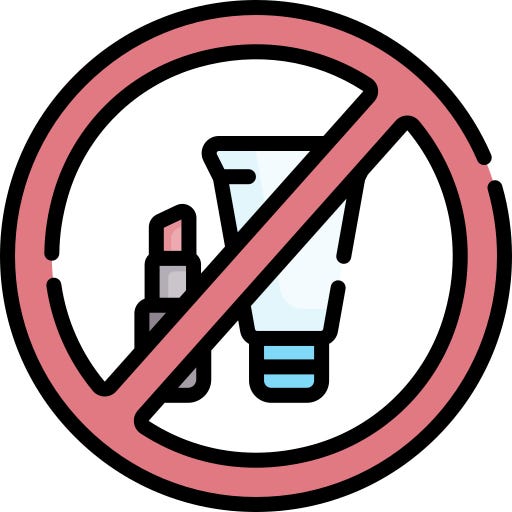

In recent years, the concept of “cycle-syncing skincare” has gained traction. It suggests that women should tailor their skincare routines to align with the hormonal fluctuations of their menstrual cycle. While this trend may sound innovative and appealing, an Ayurvedic approach provides a more holistic perspective that challenges this practice.
Understanding Cosmetics and Their Impact
The Federal Food, Drug, and Cosmetic Act (FD&C) defines cosmetics by their intended use as products “intended to be rubbed, poured, sprinkled, or sprayed on, introduced into, or otherwise applied to the human body for cleansing, beautifying, promoting attractiveness, or altering the appearance.”[i] By this definition, cosmetics do more than just sit on the surface—they are absorbed into the skin layers, influencing bodily functions in subtle but significant ways.
Cosmetics often contain chemicals such as parabens, phthalates, and other phenols. These compounds help extend shelf life, maintain color, and add fragrance. However, studies suggest that some of these chemicals, like parabens, exert estrogenic effects.
This same goes with preserved foods also, which contain harmful chemicals. [ii] Estrogen is a steroid hormone responsible for developing female sexual characteristics and regulating reproductive functions.[iii] Overexposure to estrogen, including through cosmetics, can lead to hormonal imbalances and health risks, such as:
-
Hormone-sensitive malignancies
-
Heavy menstruation
-
Irritability and mood swings
-
Headaches and sleep disturbances
-
Breast cysts
-
Endometriosis and fibroids
-
Gallbladder disease and thyroid disorders [iv]
Menstrual Cycle Phases and Hormonal Fluctuations
The menstrual cycle, typically lasting 28 days, comprises two distinct cycles—the ovarian and endometrial cycles:
-
Follicular Phase (Days 1 to 14): Starts from the first day of bleeding and continues until ovulation. Estradiol levels rise, leading to increased estrogen production.[v]
-
Ovulation (Day 14): The release of a dominant follicle.
-
Luteal Phase (Day 15 to 28): characterized by high progesterone levels, maintaining a warmer basal body temperature.
Hormonal fluctuations during these phases impact not only reproductive health but also skin health.
The Ayurvedic Perspective on Menstrual Health
In Ayurveda, the menstrual cycle is known as “Rituchakra” and is divided into three phases:
-
Ritukala: The fertile phase (follicular and ovulatory phases) is dominant in Kapha dosha.
-
Rajahsravakala: The bleeding phase, dominated by Vata dosha.
-
Rituvyatit Kala: The post-menstrual phase, dominated by Pitta dosha.
Each dosha plays a role in maintaining balance during the menstrual cycle.
-
Vata dominance: governs the bleeding phase, responsible for movement and cognition. [vi]
-
Kapha dominance: present in the follicular and ovulatory phases, linked to growth and preservation and anabolism theories. [vii]
-
Pitta dominance: seen during the luteal phase, which governs metabolism, body temperature, and digestion. [viii]
Imbalances in these doshas can lead to menstrual disorders. For example, a woman with a predominant Kapha prakriti may experience clotted menstrual blood. If she uses chemical-laden products mimicking oestrogen, this imbalance can worsen, leading to reproductive health issues.
Aacharya Charka, in ancient texts, says that one of the cause of infertility is menstrual disorders.
The Pitfalls of Cycle-Syncing Skincare
The idea behind cycle-syncing skincare is to use different products to address hormonal changes throughout the month. While the concept may sound appealing, Ayurveda advocates caution:
Chemical Exposure: Many skincare products contain chemicals that can disrupt the body’s natural hormonal balance.
Rajahswala Paricharya: This Ayurvedic guideline for menstruating women advises against excessive cosmetic use during this time. It emphasizes rest, natural cleansing, and minimal exposure to external agents.
Staying Beautiful Inside and Out
As Coco Chanel correctly said, “Elegance comes from being as beautiful inside as outside.”
Taking it like true beauty stems from maintaining balance and harmony within the body, which eventually be seen outside.
Tips for a Holistic Approach:
-
Opt for natural skincare products free from harmful chemicals.
-
Follow Ayurvedic principles, including Rajahswala Paricharya, to support menstrual health.
-
Maintain a balanced diet and lifestyle to nurture your inner self.
-
Incorporate practices such as yoga and meditation to balance doshas.
Conclusion
While modern skincare trends like cycle syncing may sound promising, they often overlook the importance of natural balance and holistic health. Ayurveda teaches us that true beauty begins from within. By adopting Ayurvedic principles and being mindful of the products we use, women can safeguard their reproductive health and embrace a more authentic approach to beauty.
Stay healthy, embrace Ayurveda, and let your inner beauty shine.
REFERENCES
[i] https://www.niehs.nih.gov/health/topics/agents/cosmetics#:~:text=The%20Federal%20Food%2C%20Drug%2C%20and,%2C%20or%20altering%20the%20appearance.%22
[ii] Engeli RT, Rohrer SR, Vuorinen A, Herdlinger S, Kaserer T, Leugger S, Schuster D, Odermatt A. Interference of Paraben Compounds with Estrogen Metabolism by Inhibition of 17β-Hydroxysteroid Dehydrogenases. Int J Mol Sci. 2017 Sep 19;18(9):2007. doi: 10.3390/ijms18092007. PMID: 28925944; PMCID: PMC5618656.
[iii] Delgado BJ, Lopez-Ojeda W. Estrogen. [Updated 2023 Jun 26]. In: StatPearls [Internet]. Treasure Island (FL): StatPearls Publishing; 2025 Jan-. Available from: https://www.ncbi.nlm.nih.gov/books/NBK538260/
[iv] Delgado BJ, Lopez-Ojeda W. Estrogen. [Updated 2023 Jun 26]. In: StatPearls [Internet]. Treasure Island (FL): StatPearls Publishing; 2025 Jan-. Available from: https://www.ncbi.nlm.nih.gov/books/NBK538260/
[v] Thiyagarajan DK, Basit H, Jeanmonod R. Physiology, Menstrual Cycle. [Updated 2024 Sep 27]. In: StatPearls [Internet]. Treasure Island (FL): StatPearls Publishing; 2025 Jan-. Available from: https://www.ncbi.nlm.nih.gov/books/NBK500020/
[vi] Bhojani M. K., Tanwar Ankur Kumar. Vata dosha. In: Deole Y.S., eds. Charak Samhita New Edition. 1st ed. Jamnagar, Ind: CSRTSDC; 2020. https://www.carakasamhitaonline.com/index.php?title=Vata_dosha&oldid=44640. Accessed January 29, 2025.
[vii] Bhojani M. K., Tanwar Ankur Kumar. Kapha dosha. In: Deole Y.S., eds. Charak Samhita New Edition. 1st ed. Jamnagar, Ind: CSRTSDC; 2020. https://www.carakasamhitaonline.com/index.php?title=Kapha_dosha&oldid=44642. Accessed January 29, 2025
[viii] Bhojani M. K., Tanwar Ankur Kumar. Pitta dosha. In: Deole Y.S., eds. Charak Samhita New Edition. 1st ed. Jamnagar, Ind: CSRTSDC; 2020. https://www.carakasamhitaonline.com/index.php?title=Pitta_dosha&oldid=44641. Accessed January 29, 2025
Consult Dr. Aishwarya Vasava in Mississauga or online
Looking for personalized Ayurvedic guidance? Explore our Twak Shuddhi skin care at Jeevdhaari Keraliya Ayurveda, 1616 Matheson Blvd Unit 25, Mississauga, or consult online from anywhere in Canada. Book an appointment or call +1 (416) 991-4809.