



Abstract:
Infertility is defined as a failure to conceive within one or more years of regular unprotected coitus. Female factor is directly responsible in 40-55% thus it is a major issue in the current era due to the growing number of incidences as a result of combination of various unwholesome environmental, social, psychological and nutritional factors. The most common causes of female infertility are ovulatory factors, endometrial and tubal factors, etc. In Ayurveda, Vata is considered to be the root cause behind all the disorders related to the female reproductive system including female infertility. Panchakarma plays an important role in treating female infertility. Basti Karma is considered as the most important treatment for Vataja disorders according to the classical literature of Ayurveda thus here, Uttarabasti is highlighted for the management of gynaecological disorders, wherein medicated oil or ghee is administered directly into the uterine cavity. Ayurvedic treatment modalities can bypass the surgical management to avoid the related burden to provide fruitful outcomes in such conditions. Present review is an effort to understand the efficacy of Uttara Basti in female infertility especially in various factors so the relevant data is collected, extracted and analysed.
Key words: Infertility,Uttarbasti, ovulatory factors, endometrial ,tubal factors
Introduction:
Infertility is failure to conceive within one or more years of regular unprotected coitus. Conception depends on the fertility potential of both male and female partner. The male is directly responsible in about 30% to 40%. Female factor is directly responsible in 40-55% among which prevalence of infertility due to ovarian factor is 15-25 %, tubal factor 25-35%, uterine factor 10 % and cervical factor 5%. [i]
According to Ayurveda, Vata is considered as a physiological force as it is responsible for the normal functioning of body systems. Infertility being a vataja disorder, demands basti karma which is having sthanika snehana and brimhana action.[ii]In various gynaecological disorders, Bastikarma has been advised through intra uterine route in the form of Uttarabasti. Uttarabasti helps in expelling the vitiated Doshas of uterus and its associated structures i.e. cervix, tubes and ovary, thereby eradicating the morbidity and diseases related to female urogenital system. It rectifies female infertility along with the factors associated to it.
The formulations used in Uttarabasti i.e. medicated oil or ghee are endowed with properties such as cleansing the uterus and increasing the strength and vitality of reproductive organs. Due to the local action and the quick penetrating and spreading properties of the drugs, it enters the minute channels and is absorbed easily. It is the best medium for the drug to cleanse the uterus, to reach the tubal lumen and remove the blockage, to strengthen and activate the endometrial receptivity and to stimulate the hormonal receptivity for normal function of reproductive system.
Definition: The Basti which is given through Uttarmarga or Utkrishta Avayava or therapeutic procedure having Shreshtha properties, is termed as Uttarbasti. Uttarmarga means, Mutra & Shukra Marga in Males and Mutra & Yoni Marga in females.[iii]
Properties: Uttarbasti is useful to alleviate Artavadushti, Shukradushti, Atya-artava, Kashtha-Artava, Yoni Vyapads and other factors related to Vandhyatwa.[iv]
Uttarbasti yantra: The Bastiyantra is also used to inject the medicine through urinary and vaginal passage for which term Uttarbasti is given. The size of Uttarbasti yantra and its part is different for male and female.
Uttarbasti yantra contains two parts
1. Basti Putak (drug holding bag)
2. Basti Netra (nozzle for inserting drug)
A) Basti putaka : Basti putaka can be made up of urinary bladder or skin of animals like goat, pig and sheep or thick cloth etc. It should be clean & without foul smell processed with Kashaya Dravyas.[v]
B) Basti Netra: Basti Netra (nozzle) should be made up of metal like gold, silver, brass etc. In shape it should be tapering like cow’s tail and smooth. Its tip should be of the size of the flower stalk of Jati, Karveera and the Sarshapa seed passing worth lumen. The nozzle should have two or three Karnikas (rings) to tie up the bag and having the length of ten or fourteen Angulas. For insertion through urethra the nozzle should have mudga seed passable lumen and ten angulas in length. It is also called as Pushpa Netra.[vi] ,[vii]
Length of Bastinetra to be inserted for women who has delivered a baby or who is in active reproductive age, four Angulas (around 4 cm) nozzle should be inserted in urinary passage. Uttarbasti should not be given to unmarried girls in vaginal passage[viii] .
Administration of Uttarbasti :
Time to Administer :
1. After shodhana of women, uttarbasti should be given during Ritukala (follicular phase or just after menses) as orifices of uterus remain open in this period.
2. Charaka told Rutukala is the most suitable time for the administration of Uttarbasti.
3. Uttarabasti should be given after 2-3 Asthapan basti during Ritukala, as during this period the yoni or garbhashaya is avarana rahita and so sneha enters & absorb easily.
Basti Matra
Uttar basti Matra in females is 3-5ml of oil/ghrita.
Uttara Basti Karma
v Classical Method [ix]
Purva Karma
· As per the derivation of the word Uttarabasti, it should be given after the administration of niruha basti, according to vagbhata, about 2 or 3 Niruhbasti should be given before the administration of Uttarabasti.
· Abhyanga and swedana karma should be done preferably over the back, groin and abdomen then yavagu added with ghee should be given for drinking.
Pradhana Karma
· The patient is made to lie down on her back. Then she is made to fold her legs at knee (lithotomy position).
· Then the basti yantra containing the prescribed dravya (either kvatha or sneha) is taken and the basti
· Netra lubricated with sneha is carefully introduced into the apatya marga.
· Basti putak is compressed uniformly, so that the dravya can enter the yoni.
· It is practically observed that kvatha returns immediately whereas sneha is retained for some time.
· Such uttarabasti can be repeated 2-3 times, in a day and also has to be given consecutively for 3 days.
· Then the patient is advised rest for 3 days before giving another course of uttarabasti.
Paschat Karma
· Rest for some time is advisable.
· As far as diet intake is concerned, Acharya suggest that after the pratyagamana of uttar basti, at evening the patient should be given milk or yusha.
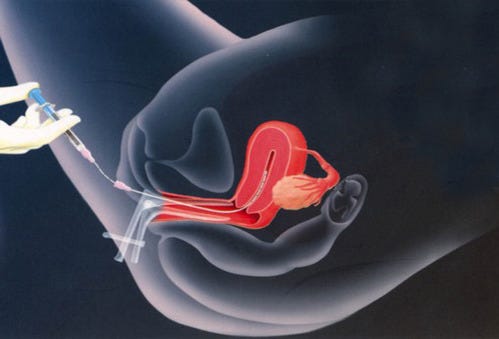
Procedure of Uttara basti : Before administration, previous infection should be cleared. After this, 2 to 3 Asthapana basti should be given to the patient. The woman should be placed in supine position with flexed thighs and elevated knee. After that Basti Netra should be inserted in vaginal passage slowly with steady hand, following the direction of passage then drug should return after some time if not return then again niruha basti or varti of purifying drugs should be used uttarbasti procedure should be carried out by an expert, under all aseptic precautions and sterilized instruments is to be used so there are no any chance of introducing any kind of infection.
v Modernized methods for administration:
Instruments Required:
1. Sponge holding forceps
2. Sim’s speculum
3. Anterior vaginal wall retractor
4. Vulsellum /Allis forceps
5. Uterine sound
6. Cervical dilator (if necessary)
7. IUI cannula
8. 5 cc syringe
9. Gauze pieces
10. Gloves
11. Towel clips
12. Good light source
Pre- Preparation :
· Counselling is done.
· Written consent is taken.
· Part preparation is done prior to procedure.
· Instruments are checked and trolley is prepared.
· Luke warm medicine is kept ready in IUI canula
· Yoni prakshalana with some antiseptic kwatha like panchavalkala /Triphala is done properly this is followed by snehana of abdomen, back, thighs and legs followed by svedana especially nadisweda on back and lower abdomen.
Procedure:
· Patient is asked to empty the bladder & to lie in lithotomy position on examination table. 2. Private parts are cleaned antiseptically.
· Sim’s speculum is inserted; anterior vaginal wall retractor is introduced to expose the vagina & cervix.
· Anterior lip of the cervix is held with the vulsellum or Allis forceps (to reduce the injury to cervix)
· Uterine sound is introduced to see the length of uterocervical canal and position of the uterus. IUI cannula is introduced the drug is injected slowly and steadily.
· Instruments are removed out.
Post- Procedure:
1. Patient was advised to extend and twist her legs, head low position given for 15 min.
2. Pulse and blood pressure recorded for two hours.
3. It is important to watch and observe that the basti dravya was expelled out properly or not and then a sterilized gauze piece kept into vagina and patient was advised to remove it after 2 hours.
4. Abdominal hot fomentation should be given which is followed by light diet.
5. Avoid the intercourse for 3-5 days post the procedure.
Mode of action of Uttarbasti
Local effect[x]
Effect of uttar basti highly depends on factors like methods, instrument and drug used etc. If the medicine is administered in cervical canal, it may act more on the cervical factors. For the factors like cervical stenosis, katu ushna taila like kshara taila based medication can be more useful, while for increasing secretion of mucus from cervical glands, a nutritive and madhur-shita ghrita based medicine will be more effective.
In the same way, the drug selection for ovulatory and tubal factor will be totally different from each other. On ovary the effect of drug will be after absorption and then by promoting the hypothalamic – pituitary–ovarian axis. While in tubal block uttar basti acts locally. In ovulation, a drug with snehana property can be good while for the tubal block a drug with lekhana karma will be better.
Uttar basti may also stimulate certain receptors in the endometrium leading to correction of all the physiological processes of reproductive system. Intravaginal uttar basti may also facilitate the absorption of drug as posterior fornix has a very rich blood supply and it may also act as reservoir of drug.
Formulations used in various factors of female infertility
1. Ovulatory factor (Anovulation)- Prajasthapana gana siddha ghrita, [xi]Shamimashvatta ghrita, [xii]Go ghrita, [xiii]Shatavari taila, [xiv]Shatapushpa taila, [xv] Mahanarayana taila [xvi]
2. Tubal factor (Tubal blockage)- Kumari taila,[xvii] Yavakshara taila,[xviii] Tila taila, [xix]Apamarga kshara taila [xx]
3. Endometrial factor (Endometrial thickness & receptivity)- Brihat shatavari ghrita, [xxi] Phalakalyana ghrita[xxii]
4. Cervical factor (Cervical mucus receptivity)- Shatavari ghrita, [xxiii] goghrita
1. Ovulatory factor
Ovum is one among the four essential factors of conception and therefore the process of ovulation is very important for the fertilization to take place. Differentiation, division and expulsion are the functions of vata. Therefore, vata is responsible for the formation and rupture of follicles resulting in ovulation.
Mode of action: Uttarabasti given in intrauterine route in the ghrita and taila medium such as prajasthapana gana siddha ghrita, shamim ashvatta ghrita, go ghrita, shatavari taila, shatapushpa taila and Mahanarayanam taila activates the normal function of vata and stimulates the ovarian hormones, ultimately achieving ovulation. Ovaries contain receptors which receive hormones secreted by hypothalamus and pituitary gland. Uttarabasti stimulates these receptors, so that proper maturation of follicles and ovulation occurs in each cycle. The teekshna and ushna property of various drugs and tila taila as a base has kapha vatahara property. These may remove Avarana kapha and might have restored the normal function of vata and follicular development. After getting absorbed in to systemic circulation when administered in the form of UB and thus would have induced hormonal influence over the ovary for the development of the follicular size.
In condition of anovulation, Uttar Basti removes the srotosangha and corrects the artavagni which regulates the menstrual cycle, thus resulting in ovulation. Ovaries contain receptors which receive hormones secreted by hypothalamus and pituitary gland. The drug stimulates these receptors, so that proper ovulation occurs in each cycle.
2. Tubal factor
Fallopian tubes play major role in the transport of gametes and embryo. Any abnormality in the form of adhesions or obstructions hampers the patency leading to infertility.
Mode of action: Correlating fallopian tubes with the artavavaha (artava-bija-vaha srotas,
its blockage is compared with the sanga srotodushti of this srotas. Vata is the prime dosha involved in tubal blockage as vata is responsible for every movement. Thus, administering intrauterine uttarabasti with drugs like kumari taila, yavakshara taila, tila taila and apamarga kshara taila having scraping, penetrating, uterine cleansing, wound healing, kapha-vata alleviating properties, does vata alleviation, act locally on tubes and removes the blockage of tubal lumen by directly flushing obstruction. It also does the lysis of adhesions and restores the normal function of tubal cilia by its rejuvenating and soothing effect. Uttarabasti cause local uterine contractions which stimulate the endometrium and ovarian receptors which stimulate the receptors and HPO axis regulating the normal menstrual cycle with ovulation.
3. Endometrial factor
Endometrium acts as bed for fertilized ovum where it gets embedded for further development. Unresponsive endometrium may cause implantation failure or abortion in early stages.
Mode of action: Uttarabasti with drugs like brihat shatavari ghrita and phalakalyana ghrita, possessing oleating, nourishing, and phytoestrogen properties, gets easily absorbed through the mucous membrane, glands, and vessels. They proliferate and nourish the endometrium and rejuvenate the local tissues, potentiating the endometrial receptors, which may finally improve the implantation rates by promoting fertilization & nidation of the embryo.
4. Cervical factor
The physical, chemical and cellular components of the cervical secretion are essential for the natural fertilization process. Deviation from the normality of the mucous secretion creates hostile environment for the entry of sperm leading to infertility. Shatavari ghrita was effective in improving the cervical mucus, cervical mucus viscocity, ferning pattern, sperm density, sperm motility whereas goghrita showed better result in cellularity and spinbarkeit test.
Mode of action: Owing to its properties, such as tridosha alleviating and the subtleness of shatavari ghrita and goghrita, they are directly absorbed by the cervical epithelium and act locally on tissues. It is passively diffused across the membranes, nourishes and regenerates the epithelial cells, and thereby normalizes the cervical secretion and reduces the sperm-hostile cervical mucus activity.
Systemic effect of Uttar Bastiafter absorption [xxiv]It seems that Ayurveda had a clear distinguishing approach between oral and parenteral route of drug administration from the very beginning. Uttar Basti may act by stimulating some neuro-endocrine pathways after getting absorbed. The systemic effect of Uttar Basti can
also be understood with the help of systemic biology concept. Systemic biology is the latest concept emerging and getting accepted in modern science. This concept believes in the holistic approach and believes that all the bodily systems and organs are interconnected at molecular level. And any change in any organ molecular level will certainly change the other. This concept is actually the first step of modern science toward the concept of Mahabhuta and tridosha. The effect of Uttar Basti drugs, have on the physiology of reproductive system, it will definitely involve the physiological functions and corrections of other organs.
[i] D.C Dutta (author). Hirala Konar (editor). Text Book of Gynaecology, Chapter16, 5th edition reprint Calcutta, New Central Book Agency (P) Ltd; Reprint 2009. p. 220, 222.
[ii] Yadavji Trikamji Acharya (editor). Charaka Samhita of Charaka, Siddhi Sthana, Chapter 1, Verse no. 34.Varanasi, Chowkambha Krishnadas Academy; 2010. p. 683.
[iii] Acharya Mukundilal Dwivedi. Ayurvediya Panchakarma Chikitsa, Delhi: Chaukhamba Sanskrit Pratishthan, Reprint 2017, P. 9
[iv] Kaviraj Ambikadatta Shastri. Sushruta Samhita,Varanasi : Chaukhamba Sanskrit Sansthan; Reprint, Chikitsa Sthan 2018;38(125):126-207
[v][v] Kaviraj Ambikadatta Shastri. Sushruta Samhita,Varanasi : Chaukhamba Sanskrit Sansthan; Reprint, Chikitsa Sthan 2018;37(107):205
[vi] Dr. Brahmanand Tripati, Ashtanghrudaya, Delhi: Chaukhamba Sanskrit Pratishatan; Sutrasthan, Chapter no 19(72):240
[vii] Mukundalal Dwivedi. Ayurvediya Panchakarma Chikitsa, Delhi: Chaukhamba Sanskrit Pratishtan; Reprint, chapter no 2017;10:915
[viii] Dr. Brahmanand Tripati.Ashtanghrudaya, Delhi: Chaukhamba Sanskrit Pratishatan; Sutrastan, Chapter no 9(70):240-241
[ix] Kaviraj Ambikadatta Shastri. Sushruta Samhita,Varanasi : Chaukhamba Sanskrit Sansthan; Reprint, Chikitsa Sthan, chapter no 2018;37(108):205
[x] Vd. Sarvesh Kumar Singh & Vd. Kshipra Rajoria, A Textbook of Panchakarma, Varanasi, Chaukhamba Prakashan, chapter no 8:518-519
[xi] Anup Jain. A textbook of panchakarma, New Delhi: Jaypee brother medical publishers: Reprint, chapter no 2019;6:403-404
[xii]Yadavji Trikamji Acharya (editor), Charaka Samhita of Charaka, Sutra Sthana Chapter 4, Verse 49,Varanasi, Chaukhambha Orientalia; Reprint 2011. p.34.
[xiii] Pandit Ramasaroop Sharma Gaud (editor). Atharvaveda, Volume 3, 6th Kaanda, 6/2/11/1,Varanasi; Chaukambha Vidya Bhaawan; 2007. p.229-230
[xiv] Late Dr.G.S Pandey, (editor). Bhavprakash Nighantu of Shri Bhavmishra, Ghrita Varga 1-6 Varanasi, Chaukhambha Bharati Academy; 2010. p. 775.
[xv] P V Tewari (editor), Kashyapa Samhita of Vriddhajivaka, Kalpa Sthana, Chapter 5, Verse 7-8, Varanasi, Chaukambha Vishwabharati; Reprint 2008. p. 348
[xvi] . P V Tewari (editor), Kashyapa Samhita of Vriddhajivaka, Kalpa Sthana Chapter 5, Verse 5-6, Varanasi, Chaukambha Vishwabharati; Reprint 2008. p. 348.
[xvii] Dr Chandra Bhushan Jha (editor) Yoga Tarangini of Trimalla Bhatta Vaidhyaraj, Chapter 40, Verse 61- 83, Varansi, Chaukhambha Vidhya Bhavana; Reprint 2003. p. 185-186.
[xviii] Pandit Sri Brahma Shankara Mishra (editor), Bhavaprakasha of Bhavamisra, Volume 2, Chapter 62, Verse 42-48, Varanasi, Chaukamba Sanskrit Bhavan; 2013. p. 612-613
[xix] Prof K R Shrikantha Murthy (translator) Bhavapraksha of Bhavamishra, Volume 1, Chapter 6 (II), Verse 252, Varanasi, Chowkambha Krishnadas Academy; Reprint 2004. p. 202
[xx] Yadavji trikamji Acharya (editor), Susruta Samhita of Susrutha, Chapter 45, Verse 112, Varanasi, Chaukambha Surabharathi Prakashan; 2008. p. 205.
[xxi] Priya Vrat Sharma (editor), Chakradatta, Chapter 57, Verse 25, Delhi, Chukambha Orientalia; 2007. p. 471
[xxii] Yadavji Trikamji Acharya (editor), Charaka Samhita of Charaka, Chikitsa Sthana, Chapter 30, Verse 64- 68, Varanasi, Chaukhambha Orientalia; Reprint 2011. p. 637
[xxiii] Prof Siddhinandan Mishra, (editor), Bhaishajya Ratnavali of Kaviraj Govind Das Sen, Chapter 67, Verse 78-84 Vranasi, Chaukambha Surabharti Prakashan; Reprint 2009. p. 1048.
[xxiv] P V Tewari (editor), Kashyapa Samhita of Vriddhajivaka, Kalpa Sthana Chapter 5, Verse 7-8, Varanasi, Chaukambha Vishwabharati; Reprint 2008. p. 348.
Consult Dr. Aishwarya Vasava in Mississauga or online
Looking for personalized Ayurvedic guidance? Explore our fertility care at Jeevdhaari Keraliya Ayurveda, 1616 Matheson Blvd Unit 25, Mississauga, or consult online from anywhere in Canada. Book an appointment or call +1 (416) 991-4809.