


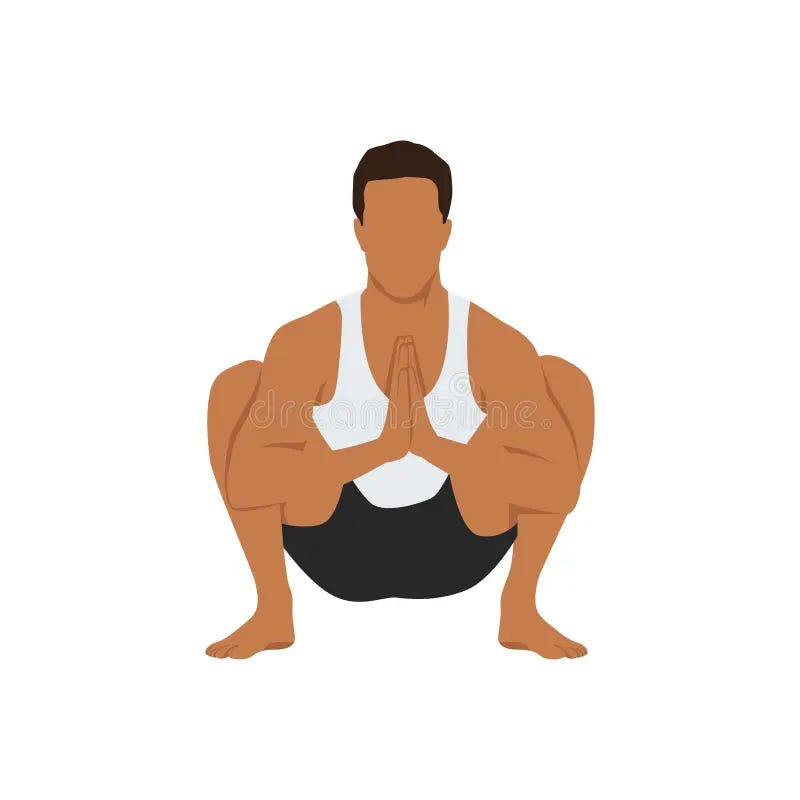

In our modern world, so many of us assume that sitting on a toilet seat is the default or “proper” way to go. But what if that posture is working against us? What if an “ancient pose” — malasana, or squatting — is in fact a simple, low‐tech way to reduce strain, ease bowel movements, and guard against problems like constipation, hemorrhoids, or diverticulosis?
In this article, we’ll review:
-
Why ancestors used squatting postures
-
How yogic / Ayurvedic traditions (e.g. malasana, anulomana) tie into this
-
Modern scientific evidence for how squatting posture helps
-
The physiology of pooping (mechanics, sphincters, anorectal angle)
-
Practical suggestions: how to adapt Western toilets (e.g. with foot-stools / squatty potty)
1. Malasana & Ancient Wisdom: Ergonomics Before “Ergonomics” Was a Word
Long before the term ergonomics existed, ancient civilizations incorporated postures and practices into daily life that optimized how the human body works. In India, Greece, China and elsewhere, people designed their tools, their furniture, their tasks around how the body functions naturally — trying to minimize strain, maximize flow, and preserve health.
In particular in ancient India, many routine daily activities — cooking, eating, working, but also defecation — were performed in postures aligned with yoga asanas (postures). These asanas were not just “spiritual”; they had a practical, physical effect. Scholars have pointed out that posture, architecture, and even furniture design in ancient India (from roughly 2500 BCE to around 1100 CE) reflect awareness of human‐body ergonomics. The aim was often to maintain the body’s natural shape, avoid repetitive stress, support joints, and allow smooth movement. Using a squat‐type posture for elimination may very well have been part of that wisdom.
This ancestral / yogic posture wisdom long preceded “ergonomics” as a modern discipline, yet it reflects the same underlying idea: align posture with physiology rather than against it.
2. Yoga, Ayurveda & Anulomana: How Malasana Fits In
Within Ayurveda and the yogic tradition, posture (asana) plays a central role in health. One of the “limbs” of traditional yoga is Ashtanga Yoga, which includes practice of various asanas to maintain bodily balance. While many modern practitioners think of yoga simply as stretching or exercise, in classical systems these postures were integrated into daily life and were believed to affect energy, digestion, elimination, breath, and the flow of vayus (subtle energies).
One relevant concept is Anulomana — often interpreted as the downward flow of energy, or the facilitation of elimination (both breath/prana and digestive waste). In this view, posture can facilitate the natural downward flow (Apan Vayu) which is responsible in yogic / Ayurvedic tradition for the process of elimination.
Malasana — the deep squat posture where the knees are deeply bent, hips low, spine upright or slightly forward — is believed to open up channels, reduce internal resistance, and allow Apan Vayu to move downward more freely. In practical terms, that translates to how the rectal canal is oriented, how muscles such as the pelvic floor and abdominal wall interact, and how gravity can assist with stool elimination.
Moreover, in many traditional Indian homes, squatting postures remained normal for activities such as cooking, cleaning, and yes, defecation — long after present‐day Western sitting toilets emerged. Yogic wisdom thus is not just about spiritual posture, but about using movement and alignment to support digestion and elimination.
3. Modern Evidence: Squatting Posture & Pelvic Floor / Digestive Health
While the traditional / yogic perspective gives philosophical and historical grounding, it’s important to examine what modern research has found. Over the past decades, multiple studies have looked at sitting vs squatting posture for defecation, and at anatomical and functional outcomes like constipation, hemorrhoids, diverticulosis, pelvic floor coordination.
Here are some key findings:
a) Scoping Reviews of Sitting vs. Squatting
A recent scoping review, “Sitting vs. Squatting: a scoping review of toilet postures and associated health outcomes”, analysed 42 studies. It found that squatting may reduce digestive strain and enhance bowel evacuation, with potential benefits on constipation. Conversely, sitting toilets may increase bowel-related issues but could provide comfort for certain populations (especially older adults). (PMC)
That review notes that while evidence is promising, methodological limitations exist (small samples, confounders), and that individual needs (mobility, joint strength) must be considered. (Springer Medizin)
b) Hemorrhoids, Diverticulosis & Toilet Type
Another study on toilet type and hemorrhods suggests that many people who habitually use squatting may have lower incidence of hemorrhoids compared to those who use sitting toilets. (bezmialemscience.org)
A more recent investigation looked at diverticulosis (small pouches that form in the colon wall) and found that sitting toilet use was associated with higher odds of diverticulosis compared to squatting. In that study, sitting toilets had an odds ratio of ~3.36 versus squatting for diverticulosis. (turkjgastroenterol.org)
These associations support the hypothesis that posture during elimination influences bowel‐health risk over time.
c) Pelvic Floor Physiotherapy in Indian Context
One specific relevant study is Pelvic Floor Physiotherapy Rehabilitation for Dyssynergic Defecation: An Approach Tailored to an Indian Setting. (Lippincott Journals)
Although it’s not strictly about squatting vs sitting posture during defecation, this study examines pelvic floor coordination, relaxation/tightness, and how therapy (including stretch / relaxation exercises) can improve evacuation. The authors report that after biofeedback & physical therapy sessions, patients improved their bowel movement frequency, reduced feeling of incomplete evacuation, and reduced pelvic floor tightness. (Lippincott Journals)
The relevance is that pelvic floor coordination (which may be influenced by posture) is a factor in proper elimination, and interventions that help muscles relax / coordinate are beneficial. Squatting posture may play a complementary role in easing coordination and reducing strain on the pelvic floor.
d) Anorectal Angle & Biomechanics
Biomechanically, squatting changes the anorectal angle. In many sitting toilets, the anorectal angle is more “kinked” because of the pull of the puborectalis muscle wrapping around the rectum. That kink helps maintain continence while standing or sitting — but it also means elimination requires more force / straining to push stool around the bend. (Wikipedia)
When squatting, the angle straightens (reported in some studies to increase the anorectal angle), reducing the resistance to stool passage. Less resistance = easier evacuation, less straining.
One early study (cited by alternative medicine / naturopathic sources) showed that the anorectal angle in squat posture could reach ~132°, whereas sitting posture was ~92° (depending on measurement). (ndnr.com)
Thus squatting allows a more “direct path” for stool to exit, reducing the need for pushing / straining.
e) Straining Time / Evacuation Efficiency
In one laboratory / field‐experiment study (referenced in popular health writing), researchers asked subjects to use three postures: entirely squatting, a half-squat / low–seat toilet, and a normal sitting toilet. They measured time to complete bowel movement and asking participants about how “complete” the evacuation felt. They found that in the full squatting posture, average time taken was ~50 seconds with a satisfactory feeling of full evacuation; when sitting, the average time was ~130 seconds and a lower sense of completeness. (lifespa.com)
While that wasn’t a large trial, it is illustrative: squatting may be more efficient in both time and completeness.
4. The Physiology of Pooping: Why Posture Matters
To understand how posture helps, we need a quick preview of how defecation works:
-
Internal & External Sphincters
-
There are two anal sphincters. The internal sphincter is under involuntary control (autonomic / unconscious), helping maintain continence. The external sphincter is under voluntary control (you can consciously squeeze it or relax it). (PMC)
-
During defecation, the internal sphincter first relaxes slightly to allow a “taster”, sensors detect whether stool is ready to pass. If the brain / mind concludes it’s safe/time to go, it signals the external sphincter to relax. If not, it stays closed, delaying evacuation.
-
-
Coordination with the Pelvic Floor & Abdominal Pressure
-
Successful pooping involves coordination: you need to generate intra‐abdominal pressure (via abdominal muscles, diaphragmatic push) while relaxing pelvic floor muscles (including puborectalis). If the pelvic floor muscles remain tight or uncoordinated when you push, evacuation can be inefficient (a condition known as dyssynergic defecation). (PMC)
-
Biofeedback therapy for dyssynergic defecation trains this coordination.
-
-
Anorectal Angle & Mechanical Resistance
-
As explained above, in sitting posture the puborectalis muscle forms a sort of sling around the rectum, causing a bend (kink). That helps maintain continence when upright, but creates resistance during defecation.
-
Squatting straightens that angle, reducing mechanical resistance, improving alignment of the rectum with the anal canal, and lets stool pass with less force.
-
-
Gravity & Alignment
-
Squatting lowers the hips closer to the perineum / ground level, which can assist gravity and reduce the vertical distance stool has to travel.
-
More importantly, it changes the shape of the pelvic floor and abdominal wall geometry, allowing the abdominal push to transmit more effectively to the rectum.
-
-
Reduced Straining & Minimizing Risk
-
Because squatting reduces the force needed, less straining is required. Chronic straining has been implicated in hemorrhoids, prolapse, anal fissures, diverticula formation, and even in some cases defecation syncope (fainting while pushing). (Wikipedia)
-
Thus posture is not just convenience — it is part of protecting tissue over time.
-
In short: defecation is not simply “sit down and push.” It is a coordinated neuromuscular event. Posture modifies how much effort is required, how well muscles coordinate, and how complete evacuation is. Using a posture aligned with physiology (squatting) helps the process.
5. Putting It Into Practice: How to Squat-Friendly Western Toilets
If you are used to a Western-style toilet (sitting style), it’s not realistic for most people to rebuild everything. But there are practical, low-cost ways to get many of the benefits of squatting / malasana:
-
Foot-Stools / Squatty-Potty Devices
-
Use a small stool (or commercial foot-stool) in front of your toilet so that when you sit, your feet are elevated a bit, knees are higher than hips, leaning forward slightly. This mimics the squatting angle without removing the toilet seat entirely.
-
Many people report faster evacuation, easier passage, less straining when using such devices.
-
-
Leaning Forward + Upper Body Posture
-
Tilt your torso slightly forward (from hips) while pushing. Leaning forward helps align your upper body with the pelvis, opening the anorectal angle further.
-
-
Squatty-Potty Style Accessories
-
There are commercial “squat-assist” devices (foot-platforms, adjustable height risers) that go around / under your toilet. These create a modified squatting posture while using a sitting toilet.
-
-
Incorporate Malasana / Squat Stretches
-
Outside of elimination time, practicing the malasana yoga posture (deep squat with upright torso, heels on floor or raised slightly) helps the hips, ankles, knees, lower back, and pelvic floor become more comfortable with deep squat alignment. Over time, this may reduce discomfort / stiffness that might otherwise make squatting posture difficult.
-
-
Gradual Habituation
-
If you haven’t squatted for years, jumping into a full deep squat (during elimination) may feel unfamiliar or even uncomfortable. Use the foot-stool approach first. Stretch your hips / ankles with yoga / asanas. Gradually increase comfort.
-
-
Tailoring for Special Populations
-
Elderly people, those with joint pain or mobility issues, may find full squat difficult. In those cases, modified squatting (partial squat, raised foot-stools, careful supervision) may still provide benefit while avoiding strain on knees / hips.
-
-
Diet / Fiber / Hydration
-
This is not posture alone. While posture helps, you’ll still need to ensure adequate fiber, hydration, physical activity, and overall digestive health. Squatting posture reduces strain — but if you are chronically constipated due to diet / medical issues, you may also need to address those.
-
6. Conclusion: Westernizing Without Losing Health
In many regions, Western-style sitting toilets have become the norm — often for reasons of convenience, plumbing infrastructure, accessibility, and social expectation. But convenience doesn’t always mean “best for your body.”
By reintroducing a small piece of ancient wisdom — squatting posture, malasana alignment — into how we eliminate waste, we can reduce straining, ease evacuation, and possibly prevent complications like hemorrhoids, diverticulosis, or chronic constipation.
Using posture-modifying devices (foot-stools), practising squat-friendly stretches, and understanding that elimination is more than “sit & push” are ways to Westernize without sacrificing our physiological health.
In essence: we don’t need to reject modern toilets entirely — but we can adapt our posture to honor what our bodies evolved to do. Poop smarter, not harder.
Consult Dr. Aishwarya Vasava in Mississauga or online
Looking for personalized Ayurvedic guidance? Explore our Agni Blossom digestion program at Jeevdhaari Keraliya Ayurveda, 1616 Matheson Blvd Unit 25, Mississauga, or consult online from anywhere in Canada. Book an appointment or call +1 (416) 991-4809.